Petite GMKtec G3 Plus N150 Box

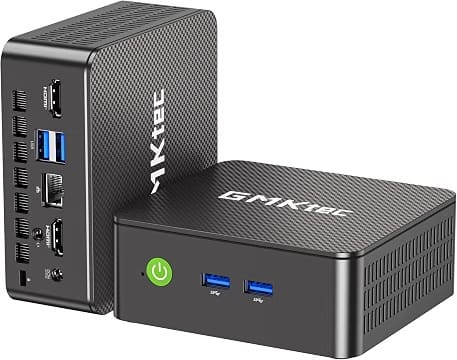
0To support home automation at the house my MIL bought nearby, I picked up a very compact mini PC to set up in her master bedroom closet. It is set up with Proxmox (despite arriving with Windows 11), running VMs for a few things:
- A Home Assistant VM. The box has both the ZBT-2 (Matter/Thread) and ZWA-2 (ZWave) Nabu Casa antennas attached to it, along with a a Bond Bridge and a Lutron Caseta Smart Bridge. The ZWave is used for Zooz ZWave water sensors, and the Lutron bridge is for a variety of connected light switches. The Bond is for the Smartwings blinds that were already present in the house.
- A VM for whatever containers, including some that are set up but not even used at this point:
- Adguard Home
- Immich
- Caddy
- Vibe coded hobby projects deployed as a container from Github
- I also run an OpenClaw on this box, with forked processes limited to a container.
- Each logical machine – the underlying Proxmox and each of the VMs deployed within it – is on my tailnet, allowing me to have them set up to basically deny all inbound traffic, exposing itself only via Tailscale.
The machine has 16 GB of RAM and a 1TB drive. Surely these are very generic and not-fast-for-the-segment components, but for $300...a great value! I'd have liked a bit more RAM for the general purpose stuff happening on the machine, but it's definitely overkill for its main charter (running the home automation).
What's hilarious is that this super cheap ($300), super tiny (4.2"x 1.7" x 4.5"), power sipping (6W) is actually faster than the now-ancient Intel i7-2600K mid-tower here in my home office. Both have 16 GB of RAM, but the N150 is actually slightly faster per core! Gemini summed it up this way:
| Metric | Intel Core i7-2600K | Intel Processor N150 | Winner |
| Release Date | Q1 2011 | Q4 2024 | — |
| PassMark Score (Multi) | ~5,483 | ~5,407 | Tie |
| Single-Thread Rating | ~1,741 | ~1,904 | N150 (+9%) |
| Cores / Threads | 4 Cores / 8 Threads | 4 Cores / 4 Threads | i7-2600K |
| Max Turbo Clock | 3.8 GHz | 3.6 GHz | i7-2600K |
| TDP (Power Use) | 95W | 6W | N150 (Massive) |
| Process Node | 32nm | 7nm | N150 |
The 2600K was high end back when I got it (2012) and the full build that it was part of was expensive at the time...but time moves on. Look at how both get embarrassed by even more modern CPUs – my prior generation Pixel (Pixel 10 Pro XL) and my iPad Pro M5:
| Metric | i7-2600K (Desktop) | Intel N150 (Mini-PC) | Tensor G5 (Pixel 10) | Apple M5 (iPad Pro) |
| Release Year | 2011 | 2024 | 2025 | 2025 |
| PassMark Multi | ~5,483 | ~5,407 | ~12,291 | ~18,400+* |
| Geekbench 6 (Single) | ~800* | ~1,200* | ~2,285 | ~4,138 |
| Geekbench 6 (Multi) | ~3,100* | ~3,000* | ~6,191 | ~16,366 |
| Cores / Threads | 4C / 8T | 4C / 4T | 8C / 8T | 10C (4P + 6E) |
| Power Use (TDP) | 95W | 6W | ~5W - 10W | ~15W - 20W (Peak) |
| *Estimated/Equivalent benchmarks for relative scale. |
This doesn't even touch on the difference in performance of integrated graphics, as this little NUC is just meant to be a headless little box to ssh into. I'd love to build a small mini-ITX sized box to replace the 2600K (with a lot more RAM), but memory and SSD prices right now are tough to swallow!